
Dual Source Single Supplier Manufacturing

Executive Summary
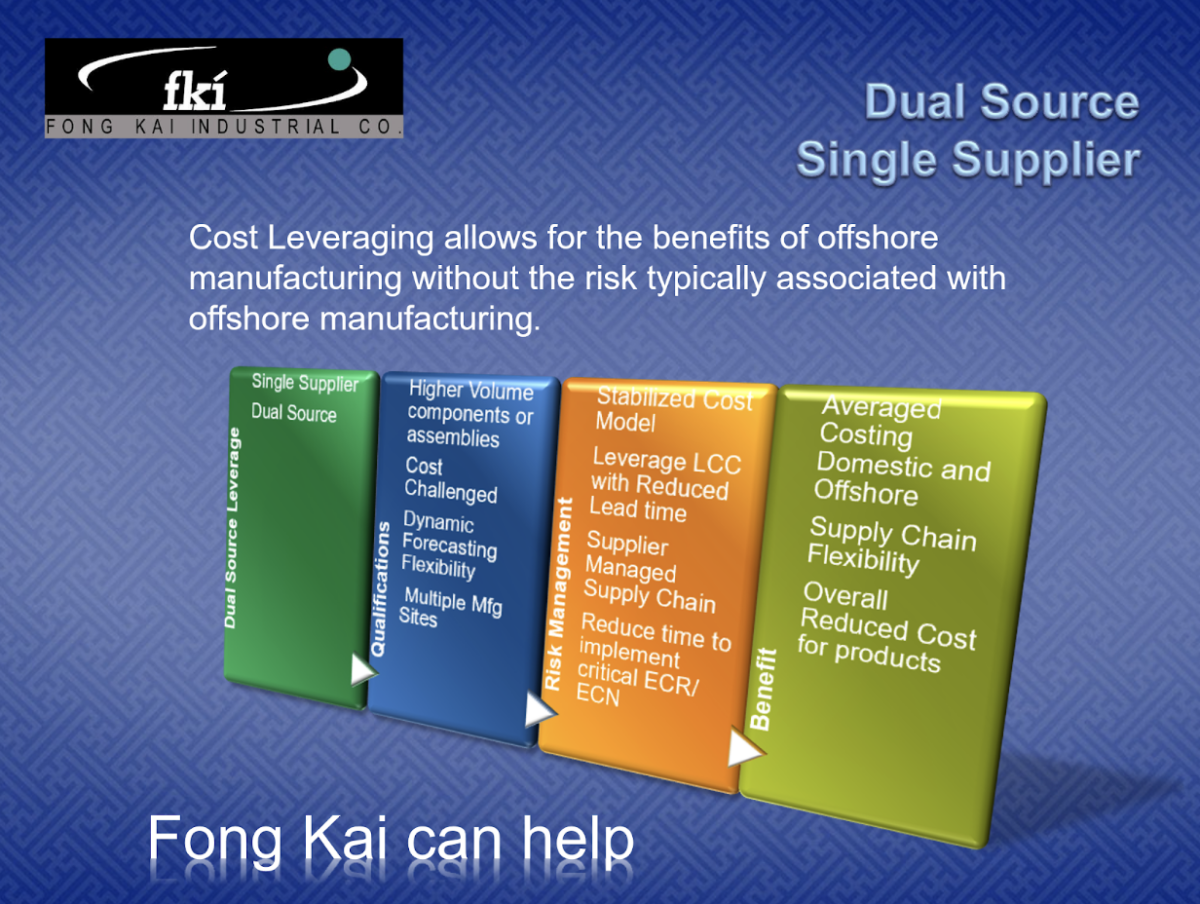
The Dual Source Single Supplier Manufacturing™ strategy eliminates the traditional compromise between offshore cost advantages and domestic supply chain security.
By pairing low cost country sourcing (LCC) directly with a mirrored domestic manufacturer, OEMs secure aggressive baseline cost competitiveness while neutralizing the threat of catastrophic logistics disruptions and expedited freight premiums.
The OEM Supply Chain Challenge & Risk Mitigation
Exclusive reliance on overseas production for Class A cosmetic metal stampings hides compounding operational vulnerabilities. True risk mitigation in the supply chain requires neutralizing the Total Landed Cost (TLC) impact of 12-to-16-week shipping cycles, port delays, and forecast variability. When demand fluctuates, the resulting component shortages force procurement teams into paying devastating expedited air freight premiums—rapidly erasing the perceived savings of offshore-only sourcing.
How the Dual Source Single Supplier™ Solution Works
FKI USA engineered a coordinated, two-location hybrid model. This supply chain consolidation strategy pairs a high-volume production site in a low-cost country directly with a secondary, mirrored site in the United States. Operating under FKI USA’s centralized corporate ownership, engineering oversight, and strict compliances and ISO 9001 quality governance.
FKI USA engineered a coordinated, two-location hybrid model that eliminates the “cost vs. risk” compromise:
- Mirrored Facilities: One production site in a low-cost country, paired with a second site in the United States.
- Unified Control: Centralized corporate ownership, engineering, and quality governance.
- Seamless Interchangeability: Standardized ISO 9001 quality systems and materials across both facilities.
This supply chain consolidation allows OEMs to leverage global cost optimization without sacrificing domestic agility.
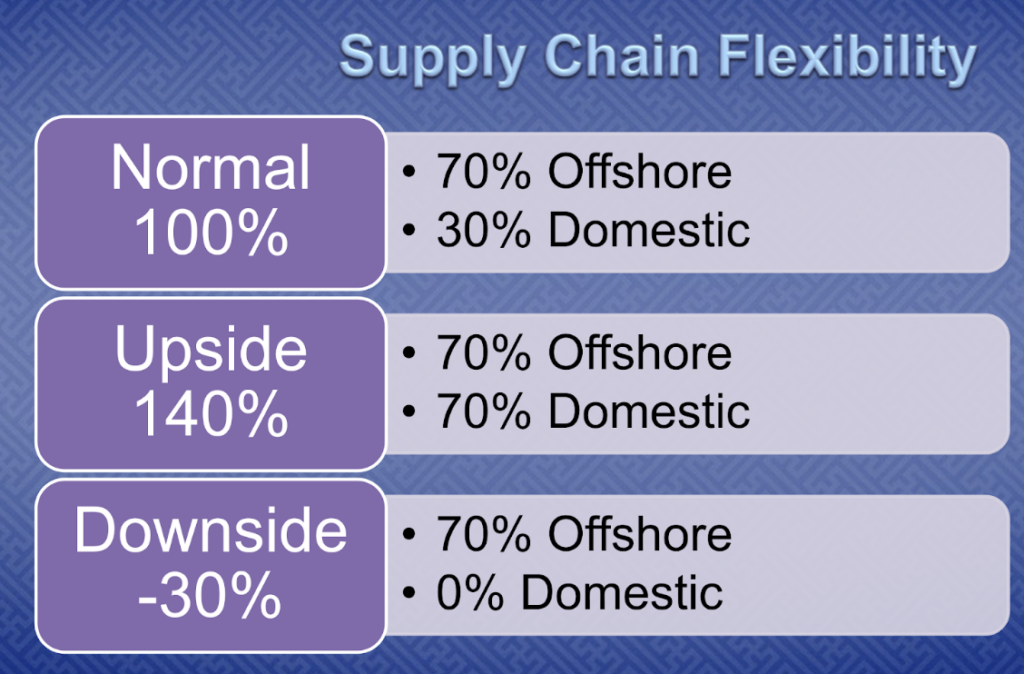
Flexible Production Response Model
When market demand spikes or global logistics are interrupted, volume is immediately dynamically shifted to the U.S. facility. This stabilizes inventory and completely bypasses the need for emergency expedited shipping.
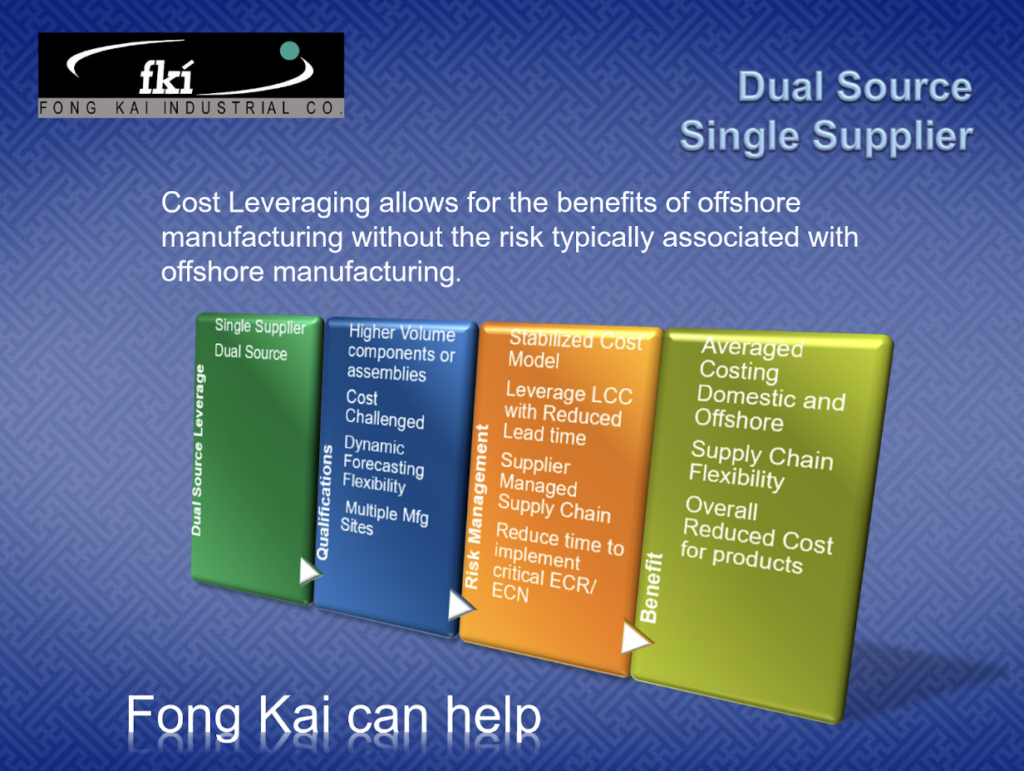
Global Supply Chain Flow & Low Cost Country Sourcing
Mirrored Facilities: One production site in a low-cost country, paired with a second site in the United States.
Unified Control: Centralized corporate ownership, engineering, and quality governance.
Seamless Interchangeability: Standardized ISO 9001 quality systems and materials across both facilities.
Tooling Strategy and Engineering Efficiency
Strategic Benefits: Cost Optimization & Supply Chain Consolidation
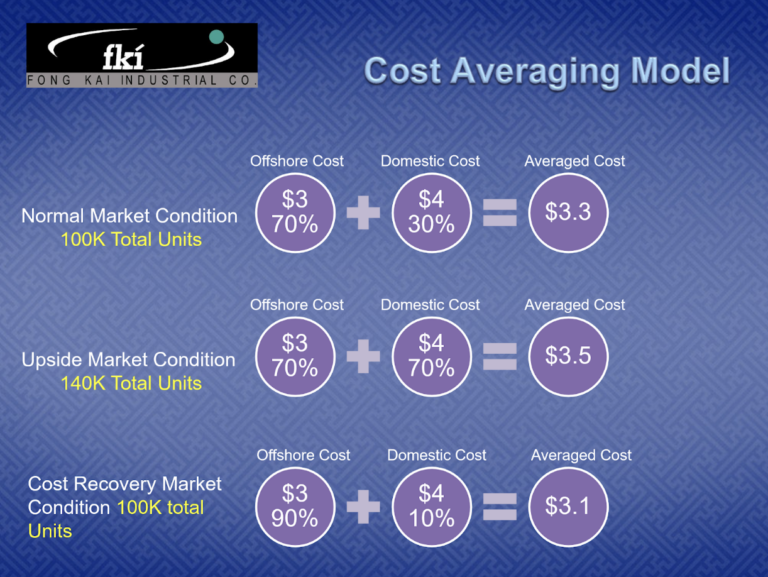
By shifting focus from “piece price” to Total Landed Cost, this blended model provides profound financial stability:
- Total program costs typically only see a 10–15% variance compared to risky, 100% offshore sourcing.
- Drastic reductions in inventory carrying costs and emergency freight exposure.
- Highly predictable cost forecasting for program managers.
The FKI USA Value Proposition for Appliance Components
Unbreakable Supply Chain: Built-in domestic redundancy guarantees active assembly lines, regardless of overseas port conditions.
- Optimized Costs: Maintains global cost competitiveness by stripping out hidden logistics premiums.
- Identical Quality: Shared process controls mean parts are 100% interchangeable, regardless of whether they are pressed in Asia or Texas.
- Strategic Flexibility: Rapid regional capacity redistribution protects against sudden market surges.
Implementation Roadmap for OEM Programs
Transitioning a high-volume component program requires expert orchestration. FKI USA executes this as a turnkey lifecycle partnership:
- Rigorous feasibility and Total Landed Cost (TLC) modeling
- Coordinated tooling design and simultaneous tool development
- Parallel facility qualification and validation
- Synchronized production ramp-up across both continents
Ongoing dynamic volume optimization managed by dedicated program teams
Proven Results from a Domestic Manufacturer
Executing this multi-continent strategy demands deep, in-house tooling engineering expertise, proven multi-site manufacturing experience, and transparent logistics coordination.
As a uniquely integrated hybrid domestic manufacturer, FKI USA possesses the infrastructure, governance, and capital assets to turn global supply chain risk into a managed, predictable competitive advantage.
More About Dual Source Manufacturing
Frequently Asked Questions
What is a dual-source manufacturing strategy?
While maintaining two suppliers may slightly increase initial tooling investments, it significantly lowers the Total Landed Cost (TLC) over the life of a program. Offshore-only sourcing often hides costs like expedited emergency freight, high inventory carrying costs, and lost revenue from stockouts.
By utilizing a hybrid model—where 75-80% of volume is produced in a low-cost country and 20-25% is produced domestically—OEMs typically see only a 10-15% variance from offshore pricing, while gaining total financial stability and avoiding catastrophic logistics premiums.
How do you maintain quality consistency across two different manufacturing locations?
The key to quality consistency in a dual-source model is simultaneous tooling development and centralized quality governance. FKI USA engineers identical tool sets for both the offshore and domestic facilities at the same time.
Because the tooling, materials, and process control systems (such as ISO 9001 standards) are perfectly mirrored under one unified corporate structure, there is zero discernible difference in the final product. This ensures full interchangeability of parts, even for highly complex, Class A cosmetic metal stampings.
What types of OEM components are best suited for a dual-source strategy?
Dual sourcing is highly recommended for critical components where a supply disruption would cause significant revenue loss or halt assembly lines. It is an ideal strategy for high-volume programs, products with volatile demand forecasts, and cosmetically critical parts (such as Class A decorative appliance components).
If a part requires long offshore lead times but demands rapid market responsiveness, a hybrid low-cost country and domestic manufacturing approach is the most effective solution.
Wondering if dual sourcing is right for your next high-volume program?
Request a Total Landed Cost (TLC) Evaluation
Send us your CAD files and annual volume forecasts.
FKI USA’s program managers will build a custom Total Landed Cost model, showing you exactly how an 80/20 offshore-to-domestic volume split can optimize your piece price while virtually eliminating your risk of supply disruption.
- Category: Case Studies
- Tag: Dual Source Single Supplier Manufacturing, Metal Stamping